Have you ever considered the possibility that the largest scientific device in human history could serve as the inspiration for an intriguing puzzle game? Deep underneath, fundamental particles are accelerated to almost the speed of light and collided to expose the secrets of the universe, turning the laws of physics into an incredible strategic game board.
When particle physics becomes a captivating puzzle game
What is LHC (for physicist)?
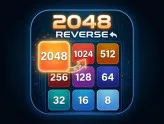
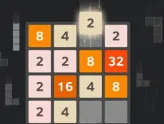
- LHC (for physicist), the famous particle accelerator at CERN, served as the model for the puzzle game LHC (for physicist). Similar to the popular game 2048, it uses movement and merging concepts, but it substitutes real particles from physics for numbers.
- The objective is more than just raising values. The elusive Higgs Boson is the ultimate goal, and you must manipulate particles, coordinating exact collisions to gradually produce new ones.
Converting the gaming board into a particle accelerator
- Imagine the screen in front of you changing from a typical puzzle grid to the enormous vacuum tube of the fabled particle accelerator.
- Each square and path on the screen functions as a strong superconducting magnet, capable of forming trajectories and accelerating basic particles.
- When the sequence is perfectly aligned, the board explodes in a brilliant shower of light and amazing physics-based effects, yet a single mistake causes the particle beam to deviate off course and disappear into thin air.
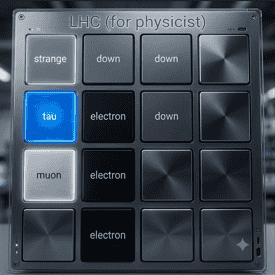
Highlights of the LHC (for physicists)
- LHC (for physicists) presents a wholly original interpretation of the renowned puzzle genre, going well beyond merely a visual makeover. The game turns the well-known 4x4 grid into a tiny lab environment.
- An experimental simulation experience: This game replicates the process of mixing elements and elementary particles, in contrast to conventional versions that only need matching lifeless numbers.
- A version for physics fans: The phrase "for physicists" draws attention to how inventive the game is. By transforming abstract particle physics theory into an intriguing, understandable, and interactive experience, it delighted scientific enthusiasts.
Travelling to the Higgs Boson
- The creation of the Higgs Boson, one of the most important particles in physics, is your ultimate goal.
- Don't move too quickly! Although LHC may appear straightforward at first, every action must be carefully considered to achieve the aim.
Examine the entire board.
- Don't concentrate only on a single pair of particles that are about to merge. Examine the entire board to identify any gaps and potential future opportunities.
Make a few plans in advance
- Multiple modifications can be triggered simultaneously by a single move. Before making a decision, try to see where the particles will end up after colliding.
Keep the board clear of clutter.
- Your mobility deteriorates when unoccupied places vanish. You have more possibilities when you allow for the appearance of new particles.
When using combo chains, exercise patience
- It's not always the best idea to create a new particle right away. Sometimes you can put yourself in a better position for future accidents by making a seemingly slower maneuver.
Why is LHC so appealing?
A distinctive scientific subject
- LHC leaves its imprint by turning seemingly boring physics concepts into an exhilarating experience of solving puzzles.
Gameplay that is accessible
- You can master your first particle-matching level in just three brief seconds.
Strategic thinking is needed.
- Your chances of getting closer to the Higgs Boson increase with each particle match; each move creates fresh space.
Combining knowledge and entertainment
- Although LHC isn't a physics lesson, players' interest in the universe of particles and the research done at particle accelerators may be piqued by its topic.
Are you prepared for the greatest collision?
LHC (for physicists) provides a genuinely novel viewpoint. It takes creative ability to turn intricate particle physics principles into captivating swipe-and-tap dynamics, where each collision reveals unexpected energy levels in addition to accumulating points.
Enter the lab, become proficient with the particle accelerator, and initiate your particle synthesis chain. Who knows? You may be able to produce something so bizarre that you'll have to yell, "Numberwang (Crazy!)" after a string of brilliant, impromptu combinations. The moment has arrived...
Category and Tags